
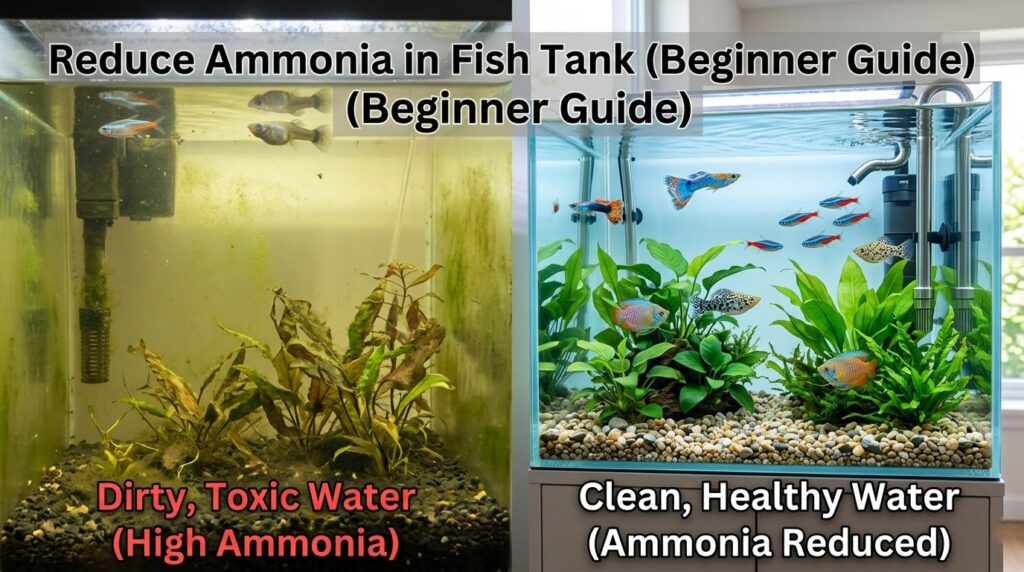
High levels of ammonia are a real threat to fish tank owners because they kill fish in a very short time, or within a few hours. In this complete guide , I will teach you how to control and deal with high-level ammonia. This guide is also for newcomers who want to save their fish from this toxic environment and gain experience to deal with future fish tank issues.
I will guide you on how quickly and safely you can lower the ammonia level.
In this guide, you will learn:
- proper water testing method
- Emergency steps
- Setting up a biological filtration system for your fish tank
- smart tank management tricks
What is the ammonia level and its effect on fish:
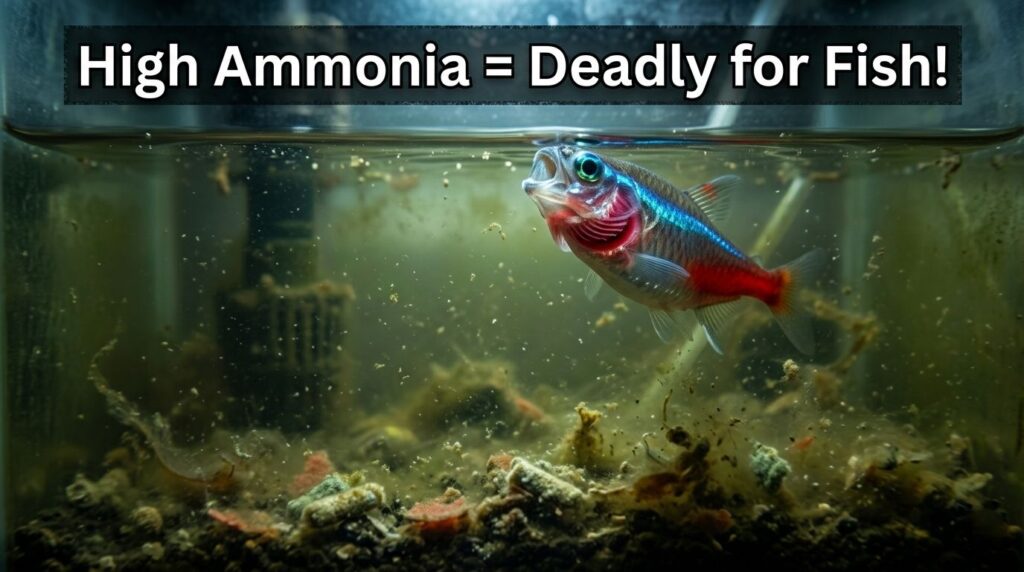
Its effect is easily seen on fish gills and organs.
Ammonia is a toxic chemical that poisons your fish tank and affects the vital systems of your fish. This ammonia enters through the fish’s gills and mixes with the bloodstream of the fish. This burns your fish’s gill tissue and turns it red/brown.
When you see your fish’s gills struggle to get oxygen from the water, it’s caused by the effect of ammonia. It also affects fish kidneys and liver. The immune system is also weakened due to the ammonia effect. When the immune system is weakened, it’s open for bacteria and fungi to attack fish. It increases the infection rate in fish.
Ammonia also affects the nervous system of fish; due to this, sometimes fish lose their balance or develop neurological problems.
When you find out these problems in your fish, immediately take action; otherwise, it progresses very quickly, which causes the death of your fish in a few days.
Optimal ammonia level for different species:
The optimal healthy ammonia level is zero, so don’t tolerate it because a small amount of ammonia kills your fish.
Some fish species show stress to ammonia at very low levels, like angelfish and many marine fish.
How ammonia builds up in the tank:
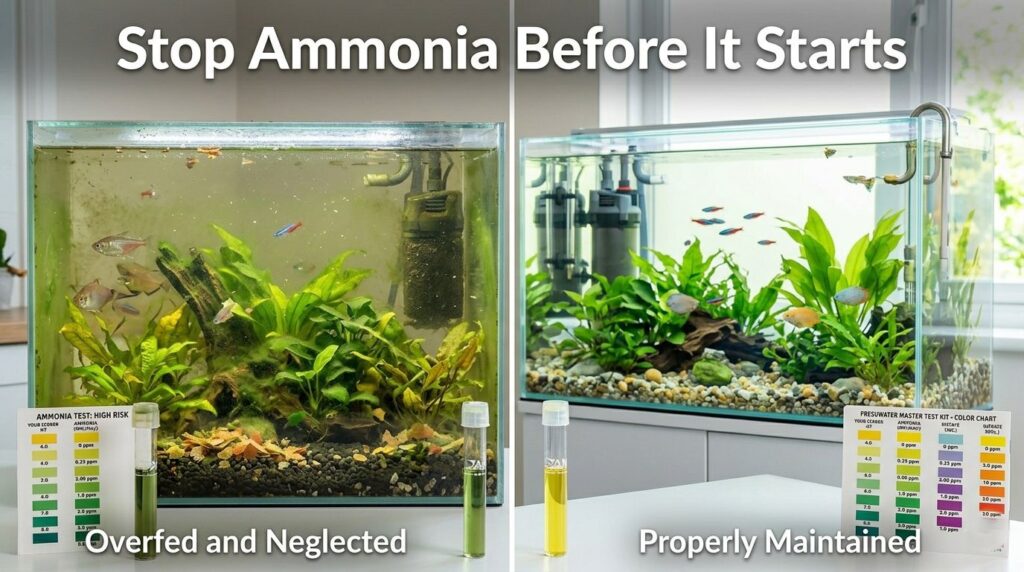
When fish eat food, they produce ammonia as waste through their gills and urine. Also, uneaten or overfed decompose on the substrate of the tank, then convert into ammonia and enter the tank water.
The nitrogen cycle controls ammonia levels through beneficial bacteria. It takes 4-8 weeks in a new tank to progress.
Several factors accelerate ammonia buildup:
- Overstocking your tank with too many fish
- Overfeeding, leaving excess food to rot
- Inadequate filtration for your bio load
- Cleaning your filter too aggressively, removing beneficial bacteria
- Adding new fish without quarantine
- Medications that kill beneficial bacteria
- pH swings that stress the nitrogen cycle
Test your tank water regularly to detect ammonia:
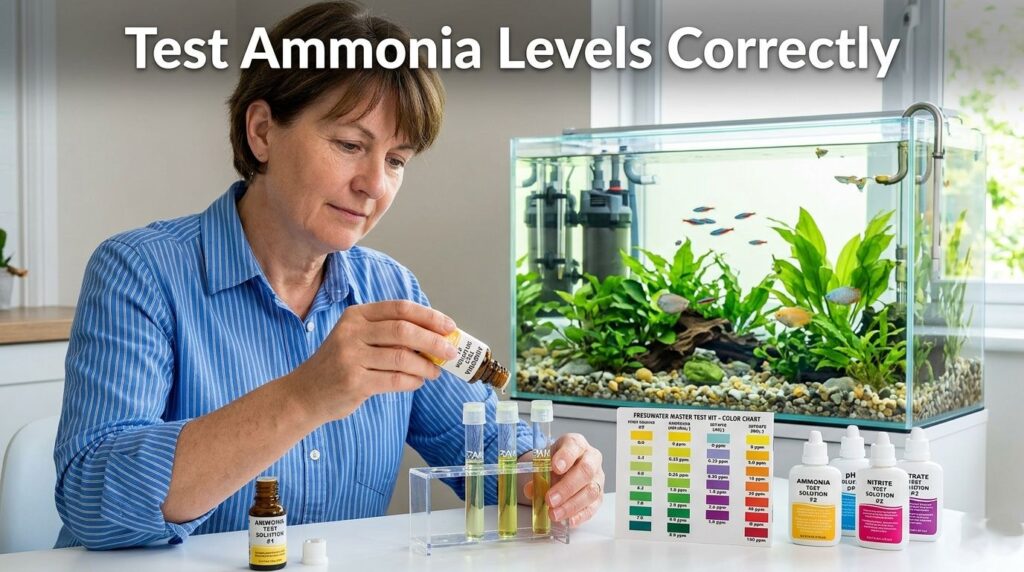
Choose the right ammonia testing kit:
Choosing the right testing kit helps you detect early warning of ammonia levels in your fish tank.
Liquid test kits give better and more accurate results than test strips.
Digital meters cost more but eliminate guesswork completely. This equipment gives a proper ammonia level in numerical reading.
Morning testing gives better results because at that time, fish are less active and ammonia builds up during the night.
Test immediately if you notice red gills or gasping of your fish on the tank surface.
test results and warning signs:
- Ammonia levels should read zero in healthy, established tanks. Any detectable ammonia signals trouble brewing. Here’s what different readings mean:
- 0 ppm: Perfect – your biological filtration is handling the bio load
- 0.25 ppm: Yellow warning – increase testing frequency and prepare for water changes
- 0.5 ppm: Orange alert – immediate 25-30% water change needed
- 1.0 ppm or higher: Red danger zone – emergency water changes and investigate the cause
Emergency steps:
- change 25-50% of tank water
- Check the replacement water temperature. Ensure it is equal to the tank water temperature.
- Use conditioner to neutralize the chlorine and chloramines
- Change water every 12-24 hours until ammonia drops to zero level
- Add a beneficial bacteria supplement to boost biological filtration
- Reduce fish feeding by 50-75% to reduce waste production.
- Add an extra pump to increase oxygen flow in the tank water because bacteria need a good amount of oxygen to work quickly.
Cycling timeline:
1-7 days:
ammonia rise
no bacterial growth
8-14 days:
bacteria grow
Bacteria change ammonia to nitrate
So nitrate appears, and ammonia drops slowly
15-30 days:
nitrate form, which further changes into nitrites, which are less harmful
31-45 days:
No ammonia and nitrate present, only nitrite remains, which is not harmful.
For quick action:
Do a 25-50% water change. Or use only dechlorinated water. Temporarily reduce feed to the fish. Remove dead fish, leftover food, and dead plants from the tank. These are the reasons for ammonia formation. It is more important to reduce the source of ammonia rather than reducing temporary ammonia. Because when the source is reduced, ammonia will automatically be produced less.
Grow beneficial manure bacteria in the pond:
Beneficial bacteria are very important for a healthy manure pond. To grow them, cycle the pond for 4 to 5 weeks, during which beneficial bacteria grow, or then add fish. During the cycle, put fish feed in the tank, which is a nutritious food for bacteria to grow. These bacteria destroy the highly toxic substances in the pond and make them less toxic as nitrates. To grow bacteria in a new tank, add a filter sponge from an old tank to the new tank, and these bacteria will grow quickly. Or add gravel from any old pond in the new tank, and these bacteria grow quickly. Initially, add fewer fish; there may be an imbalance of bacteria. Tap water contains chlorine, which can kill bacteria, so use anti-chlorine. Bacteria need oxygen all the time, so keep the filter running 24 hours a day.
Reduce the source:
Don’t overfeed the fish. Feed the fish as much as they can eat in 2 to 3 minutes. Clean the gravel vacuum, leftover food, fish waste, and gravel. Add live plants, which absorb ammonia and help in reducing it. Clean the filter regularly, but clean the old water in the tank; tap water kills beneficial bacteria. Remove dead fish or other dead bodies from the tank; these are the source of ammonia. Avoid keeping too many fish in the tank.
Use natural ammonia reducer:
Add live plants to the pond; they absorb ammonia, which will reduce the ammonia. Use floating plants, such as Duckweed, Hornwort, and Anacharis . Change 20 to 30% water; this will reduce ammonia, but use dechlorinated water.
Upgrade Filtration System:
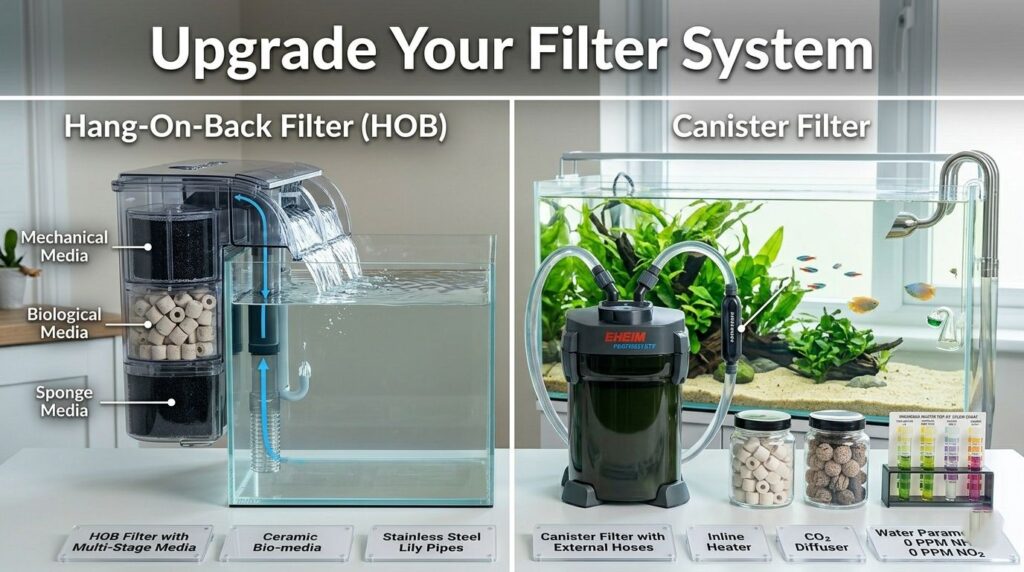
If you have a normal sponge filter, add ceramic rings or bio balls to it as these bacteria grow and reduce ammonia production. Add bacteria booster pads available in the market to the tank; this helps in quick filtration. Use zeolite or ammonia remover pads in the filter, as these reduce ammonia production. Use zeocarb ponds, which have either activated carbon or zeolite. If your pond has a small filter, use a canister filter or (HOB) hang-on-back filter pads, as these have more space and filter the water more effectively. Sponge filters are good for small ponds as they are beneficial for small ponds and have more space. Clean the filter media with tank water. Tap water can kill bacteria. Use Sachem Prime or API Ammo-Lock, as it detoxifies ammonia.
If the ammonia level becomes too high, then use the chemical:
Use ammonia neutralizers like API Ammo Lock, Kordon Amquel , and Tetra Aqua Safe. These neutralize ammonia, which reduces the stress of fish, but it is not a permanent solution as it shows effect only for 24 to 48 hours. Use zeolite media, which absorbs ammonia and reduces stress. Normally, use 5ml or 1 spoon of the chemical in 38 liters of water, but take precautions before using it. Do not wash the filter with tap water, as this kills beneficial bacteria. If ammonia is high, then reduce the fish feed or stop it for a day because leftover food forms ammonia.
Maintain a suitable routine in the tank:
Change 30 to 40% water weekly, which reduces the nitrate and ammonia and keeps it maintained. Test the water regularly and make a schedule for testing. Do not feed the fish more than required. Do not clean the tank more than required. Do not keep too many fish in the tank; keep as many as you can easily maintain according to the size of the tank. Do not keep the tank in too much light. Clean the filter regularly. Do not ignore even the smallest things; this is the source of bacterial problems. Observe the fish in the tank; this is how you get an idea of the condition of the tank.
Pro tips for long-term:
Cycle the tank and then add the fish. It’s good for fish and also for tank health . Quarantine new fish before adding them to the tank . Monitor after adding new fish or new stock . regularly test water with test kits . Do not ignore small issues . It may cause a big problem .
Conclusion:
Controlling ammonia is not that difficult. It can be controlled with consistent care. Do not use too many chemicals, as this is not a permanent solution. Add plants to the pond, observe the fish, and keep the water level in check. Control waste and avoid overfeeding. Build beneficial bacteria in the pond. Maintain the tank.